Authors:
Historic Era: Era 8: The Great Depression and World War II (1929-1945)
Historic Theme:
Subject:
| Volume 71, Issue 5



Authors:
Historic Era: Era 8: The Great Depression and World War II (1929-1945)
Historic Theme:
Subject:
| Volume 71, Issue 5


Many veterans came home from World War II with what is now known as PTSD, but it usually went undiagnosed and untreated.
| Volume 71, Issue 5
Editor's Note: David Nasaw is a professor of history at the City University of New York and the author of numerous books including biographies of Andrew Carnegie and William Randolph Hearst. His most recent, The Wounded Generation: Coming Home After World War II, is an important reminder of the extraordinary contributions of so many members of the "Greatest Generation." Portions of this essay appeared in that book.
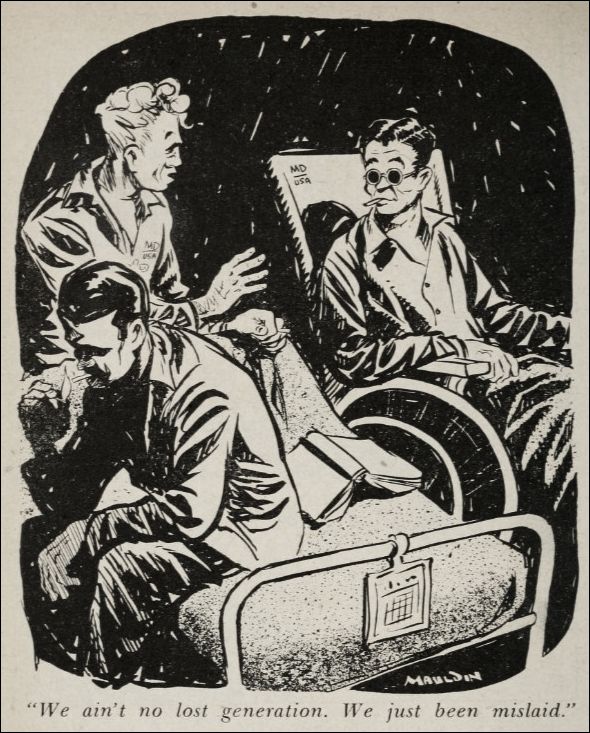
In its duration, geographical reach, and ferocity, World War II was unprecedented, and the effects on those who fought it and their loved ones at home, immeasurable.
The veterans who returned home were not the ones who had left for war. “They are very different now,” wrote the GI cartoonist Bill Mauldin in Up Front, published in June 1945. “Don’t let anybody tell you they aren’t.... Some say the American soldier is the same clean-cut young man who left his home. They are wrong.”
Most returning veterans found it difficult, if not impossible, to get a full night’s sleep. Many were troubled by recurring nightmares and flashbacks. They were irritable, angry, plagued by uncontrollable rages, feelings of social isolation, and fears of places and events that evoked memories of the war, their proximity to death, and the dead left behind. Large numbers sought relief by drinking to excess, as they had during the war and while awaiting repatriation.
Those who sought professional help were told that they suffered from nothing more than battle fatigue that time would cure. It did not. The true cause of their distress, post-traumatic stress disorder (PTSD), would go undiagnosed and untreated for decades to come.
Nearly 16.4 million Americans, 12 percent of the total population, 32 percent of males between eighteen and forty-five, served in the armed forces of the United States in World War II. They left behind four million spouses, two million children, and tens of millions of parents, siblings, lovers, friends, and neighbors. The after effects of the war lived on in the bodies, hearts, and minds of those who fought, those who awaited their return, and the nation that had won the war but had now to readjust to peace.
The war itself lasted nearly four years. The men and women who fought it on two oceans, in the air, and on the landmasses of Africa, Alaska, Asia, Europe, and the islands of the Pacific served an average of thirty-three months, three-quarters of them overseas for sixteen months on average, three times as long as their counterparts in World War I. Never before or since have so many been called away to