Authors:
Historic Era: Era 3: Revolution and the New Nation (1754-1820s)
Historic Theme:
Subject:
Winter 2026 | Volume 71, Issue 1



Authors:
Historic Era: Era 3: Revolution and the New Nation (1754-1820s)
Historic Theme:
Subject:
Winter 2026 | Volume 71, Issue 1


Our nation came into being thanks to an unexpected explosion of political talent in an emerging nation on the fringe of the Atlantic world.
Winter 2026 | Volume 71, Issue 1
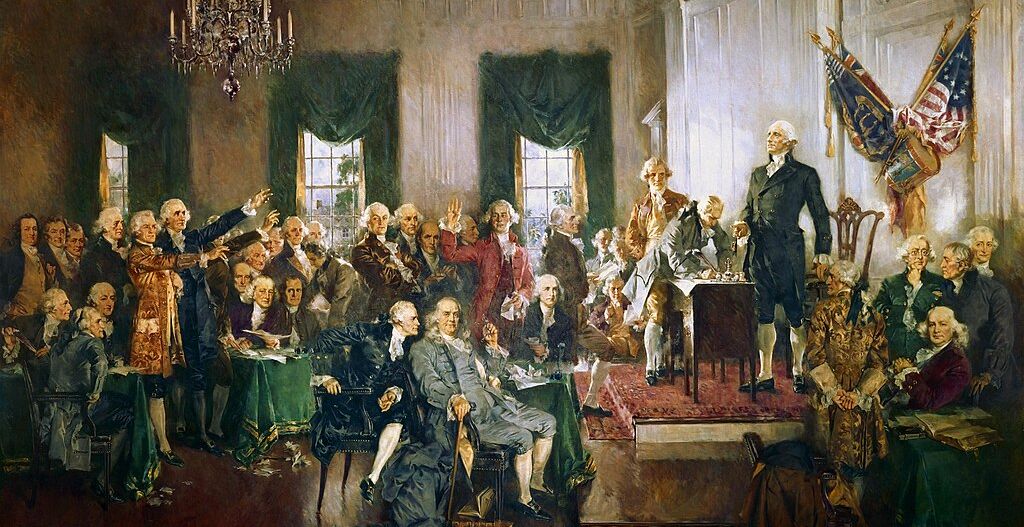
Editor’s Note: Joseph Ellis is the author of numerous books on the Founding Era and winner of the Pulitzer Prize for History and the National Book Award, among other honors. Portions of the following essay appeared in his book, American Dialogue: The Founders and Us, which explores the relevance of the views of the Founders to issues in America today.
The British philosopher Alfred North Whitehead once observed that there were only two occasions in the history of Western civilization when the political leadership of an emerging nation behaved as well as anyone could reasonably expect. The first was Rome under Caesar Augustus; the second was the United States under that collection of characters called the founders.
The clear consensus among scholars is that the political leadership that emerged in the last quarter of the eighteenth century displayed more creative talent than any subsequent generation of American statesmen. Polls of historians and political scientists routinely rank Abraham Lincoln and Franklin Roosevelt ahead of George Washington on the list of great American presidents, but the range of political creativity surrounding Washington, chiefly Adams, Jefferson, Franklin, Madison, and Hamilton, has no serious competitor as a gallery of greats.
How to account for this unexpected explosion of political talent in an emerging nation on the fringe of the Atlantic world is a question that has attracted multiple explanations, both at the time and ever since. Over fifty years ago the historian Douglass Adair put the question most mischievously. The white population of Virginia in 1790 totaled about 400,000 souls, Adair noted, which was slightly smaller than the current population of Wilkes-Barre, Pennsylvania. If we conducted a rigorous survey of the residents of Wilkes-Barre, could we expect to find the likes of George Washington, Thomas Jefferson, James Madison, Patrick Henry, George Mason, and John Marshall? Obviously not.
Such juxtapositions, the historical equivalent of shooting fish in a barrel, should be avoided at the start, since it ends the conversation about leadership before it can begin. Similarly, one explanation for the singular status of the founding generation needs to be ruled inadmissible: there can be no reference to divine intervention. Soon after their departure, a thick cloud of incense formed around the founders that required over a century to dissipate. But it is still fashionable for some wholly secular historians to use words like miracle, sacred, and godlike to describe the achievement of the revolutionary generation.
Such lingering vestiges of religiosity corrupt any serious inquiry into the sources of their creativity. The founders desperately wanted to be remembered. But they must not be canonized.
What, then, did